Custom Cosmetic Formulation and Product Development in India
Turn an idea into a safe, stable, pleasant-to-use formula. Our R&D team develops it in our own laboratory, refines it with your feedback and scales it to production under one roof.

What custom cosmetic formulation means
Custom cosmetic formulation means a formula is developed for your product instead of picked from a ready range. You describe the customer, the product, the feel and the claims; a formulation team turns that into a recipe that is safe, stable, pleasant to use and possible to make at production scale. Cosmetic product development in India covers that whole path, from the first brief to the first production batch.
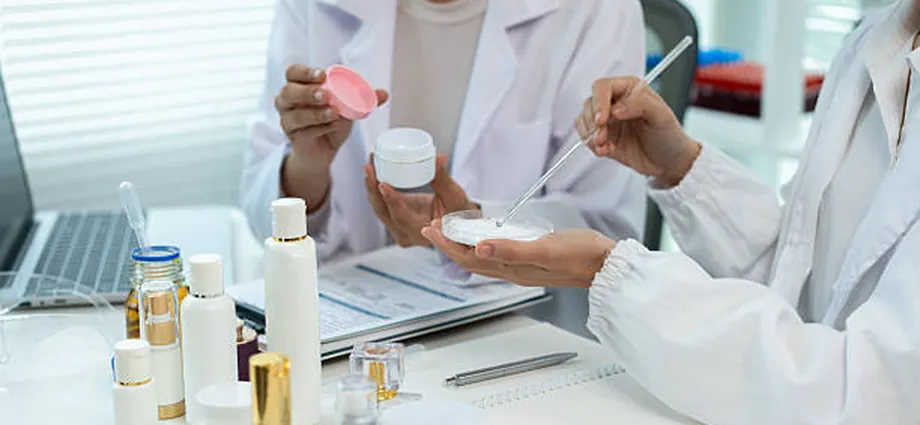
At Formuluxe the R&D team works in our own laboratory in Pundri, Haryana. The same site makes, fills and packs the product, so the people who develop the formula and the people who run the first batch are in one place. That is what makes scale-up easier: problems found in the lab are fixed before they cost you a production run.
| Route | What happens to the formula | Start |
|---|---|---|
| Private label | You choose a ready-tested formula and add your brand, scent and pack. Little or no development work. | 1,000 units |
| Third-party, custom formula | We develop the formula end to end from your brief, with samples and refinement. | 2,000 units |
| Third-party, your own formula | You bring a formula. We review it, make a sample and can refine it for stability and scale. | 2,000 units |
Start with a ready formula if speed and a small first order matter most. Choose custom development when the product itself is your difference: a texture, an ingredient story, a claim or a skin concern that ready formulas cannot meet. See private label vs third-party manufacturing for the trade-offs.
How a formula is developed, step by step
- 01Brief and feasibilityWe read your brief and tell you plainly what is achievable, what needs trade-offs and what is not realistic.
- 02Concept and baseWe choose the formula type, base system and a first list of ingredients.
- 03Lab prototypeSmall lab batches in our in-house laboratory, adjusted for texture, finish and scent.
- 04Sample and feedbackYou test a free sample and send structured feedback in writing.
- 05RefinementWe change one thing at a time and re-sample until you approve.
- 06Stability and scale-upStability and packaging checks, then a first production batch with batch records.
These stages are the same for a face serum and a hair mask, but the effort at each stage is not. A simple wash can reach a good sample in few rounds; an emulsion with a delicate active may take several. We do not promise a fixed number of rounds, because the honest answer depends on the brief. We tell you what we see as the work goes on.
Production timelines are quoted separately: about 6 to 8 weeks on third-party manufacturing once the formula and pack are approved. The How it works page shows the full journey, and the launch checklist shows how formulation fits into a 90-day plan.
What to tell the R&D team
The quality of a formula depends heavily on the quality of the brief. Vague briefs lead to extra rounds. A useful brief answers these questions:
| Tell us | Why it matters |
|---|---|
| Who the customer is and their skin or hair concern | Sets the actives, mildness and sensory targets |
| The product type and the format | Cream, gel, serum, oil, wash and mask need different bases |
| Texture and finish you want | Rich or light, glossy or matte, fast or slow absorbing |
| Scent and colour | Fragrance-free, light scent or signature scent; colourless or tinted |
| Ingredients you want or must avoid | Vegan, fragrance-free, herbal, or a named active |
| Claims you want to make | Claims shape the formula and the testing. See cosmetic claims in India |
| Pack and dispensing | Pump, tube, jar or dropper affect viscosity and compatibility |
| Price and quantity | Ingredient cost has to fit your selling price |
| A reference product, if any | Shows the target feel faster than words |
Our guide to briefing a cosmetic manufacturer includes a filled-in example.
How ingredients are chosen
Ingredient selection is a set of trade-offs, not a shopping list. For each role in the formula, a chemist weighs the same questions:
The main roles in a typical formula
| Role | What it does | Examples of the kind of ingredient |
|---|---|---|
| Water or solvent phase | Carries water-soluble ingredients | Purified water, glycols |
| Emollients and oils | Soften, add slip and cushion | Plant oils, esters, butters |
| Emulsifiers | Hold oil and water together | Emulsifying waxes, polymeric emulsifiers |
| Humectants | Draw and hold moisture in the skin surface | Glycerin, hyaluronic acid, panthenol |
| Thickeners and stabilisers | Set texture and keep the formula uniform | Gums, polymers, fatty alcohols |
| Actives | Deliver the targeted benefit | Niacinamide, vitamin C derivatives, exfoliating acids, plant extracts |
| Preservative system | Protects water-containing products from microbes | Chosen to suit the formula and pH |
| Antioxidants | Slow rancidity in oils and sensitive actives | Tocopherol and similar |
| pH adjusters and chelators | Hold pH and improve stability | Citric acid, sodium hydroxide, chelating agents |
| Fragrance and colour | Scent and appearance | Cosmetic-grade, from permitted lists |
The examples show what each role does; they are not a promise that a given ingredient will go into your product. The final list depends on your brief, the safety assessment and the tests. Every ingredient is declared on the label. See label requirements.
Formula types and what each needs
The format you choose decides the base system and most of the development work.
| Format | Base | Development focus |
|---|---|---|
| Lotions and creams | Oil-in-water or water-in-oil emulsions | Emulsion stability, skin feel, preservation |
| Serums and gels | Water-based, thickened | Clarity, actives stability, pH, tackiness |
| Facial oils and balms | Anhydrous (no water) | Oxidation, melt point, texture in heat |
| Cleansers, shampoos, body wash | Surfactant systems | Foam, mildness, viscosity, rinse feel |
| Masks and hair treatments | Emulsions or clays | Spreadability, rinse-off, conditioning |
| Sun care | Emulsions with UV filters | Extra performance testing and claim support |
We make 15 categories. Browse skincare, sun care, hair, body and more to see what each category covers. Ayurvedic and herbal formulas bring their own questions; read our guide to starting an herbal brand.
Choosing actives and staying within cosmetic rules
A cosmetic cleanses, beautifies or alters appearance. It does not treat disease. This line shapes both the formula and the words on your label. Strong actives raise irritation risk and claim risk together, so we help you choose a level that fits the claim you can honestly make.
Sample development and refinement
You will judge the sample by how it feels, so give feedback in the same terms your customer would. The more specific your note, the faster the next round.
| Feedback area | Useful notes | Difficulty to change |
|---|---|---|
| Texture and spreadability | Too thick, too thin, drags, pills | Usually easy |
| Absorption and finish | Greasy, tacky, matte, dewy | Usually easy |
| Scent | Too strong, too faint, wrong note | Usually easy |
| Colour | Shade, intensity | Usually easy |
| Active or benefit | Add, remove or change an active | Harder; restarts stability and safety checks |
| Pack or dispensing | Pump does not dispense well | Medium; may change viscosity |
Samples are free; you pay shipping only. Test across several days on people who match your customer, compare with your reference product and approve in writing. Request a free sample once your brief is ready.
Stability, compatibility and safety checks
A formula that looks good on day one is not finished. Stability testing shows how it behaves over time, heat, cold and light, and in its real pack.
Our R&D team runs stability tests and checks packaging compatibility in our lab before a formula goes into production. Safety assessment and claim substantiation depend on the product and the claim, so we agree the needed tests with you early. Read stability testing for cosmetics and ISO 22716 and GMP for the detail.
From lab batch to production
A lab batch of a few hundred grams behaves differently from a large production batch. Heating and cooling take longer, shear and mixing change, and fill lines add their own demands. Scale-up is where many formulas show problems that the lab did not.
Who owns the formula
Ask who owns the formula before development starts, and get the answer in writing. At Formuluxe every project and formula is kept confidential. Agree in writing who owns the formula, the test data and any transfer rights. Our guide to contract manufacturing explains the points to cover, and the manufacturer scorecard helps you compare partners.
When custom formulation is worth it
| Choose | If |
|---|---|
| A ready-tested formula | You want the fastest, lowest-minimum start and a standard product will do |
| Custom formulation | The formula is your difference, or ready formulas do not meet your brief |
| Refining your own formula | You already have a formula that needs stability work, scale-up or a better feel |
Pricing for development and production is quoted per project once we see your brief, so we do not publish a single figure.
Questions on custom formulation
Do you develop custom cosmetic formulas in India?
Yes. Our R&D team and in-house laboratory in Pundri, Haryana develop a safe, stable formula for your product, with sampling support.
What is the difference between custom formulation and private label?
Private label uses a ready-tested formula you brand. Custom formulation develops a formula for your brief. Private label starts at 1,000 units; third-party with a custom formula starts at 2,000.
Can I bring my own formula?
Yes. Third-party manufacturing lets you bring your own formula. We review it, make a sample and can refine it for stability and scale.
Do I need a formula to start?
No. Share your idea, customer and product feel, and we develop the formula end to end.
Are formulation samples free?
Yes. You pay shipping only.
How many sample rounds will I need?
It depends on the brief. Simple products often need fewer rounds; emulsions and sensitive actives may need more. We tell you what we see as work goes on.
How long does development take?
It depends on the product and the number of rounds. Once the formula and pack are approved, production takes about 6 to 8 weeks on third-party manufacturing.
Show all 12 questionsShow fewer questions
Do you test stability?
Yes. Our R&D team runs stability tests and checks packaging compatibility before a formula goes into production.
Who owns the formula?
Agree this in writing before development starts. We keep every project and formula confidential.
Can you make vegan, fragrance-free or herbal products?
Tell us in the brief. We design the formula around the constraint, and we will say if a requirement limits texture or stability.
What does custom formulation cost?
It is quoted per project once we see your brief, so we do not publish a single price.
Can you reformulate a product I already sell?
Yes, tell us what to change, such as texture, scent, stability or an ingredient, and we will advise what is realistic.
Have a product idea?
Share your brief. We will tell you what is achievable and send a free sample. You pay shipping only.